[interview #4: This must be a *Conspiracy*...................]
From the suburbs of Hungary to the top of the Demoscene...
From the suburbs of Hungary to the top of the Demoscene...
Revision 2016 was the definitive proof that 64k intros have still something to say.
Conspiracy is one of those demogroups that made 64ks the main reason of their existence.
In fact, they are in activity back from 2003, and released mostly 64k intros, a pair of 4ks and a couple of demos (one of them could have been a 64k too).
I asked for an interview to Gargaj, musician/coder/demoscene-myth of Conspiracy, shortly after their return from Revision, where Conspiracy placed 2nd right after Mercury (see the results here), and he extended the questions to the rest of the group.
Warning: if you are among the 3 demo freaks that have been on the moon recently and haven't seen "Darkness lay your eyes upon me" (DLYEUM from here after), stop reading this and go watch the intro (this interview contains spoilers and tool screenshots that would ruin the experience).
Then come here again (if you remember the address).

1) Almost 13 years have passed since "project genesis". That intro amazed for the incredible amount of content and for the general cleanness of the scenes. What has changed between the tool used to build "project genesis" (a.d.d.i.c.t. 0.9) and the tool used to create DLYEUM? In which way is the tool used to build DLYEUM "better" than the first one?
A lot has changed, and a lot hasn't.
For one, we learned to code and not just mess around. The tools became pretty sophisticated compared to the first iteration. They are faster, stable, easier to work with and can do a lot more. We overcame several limitations that seemed impossible back then, and not just because of the increase in processing power or the advent of shaders. The tools we used until 2006 had no notion of pixel or vertex shaders, they used fixed pipeline GPU acceleration. Our current generation tool has ditched CPU based texture generation for a GPU based one, and has a proper material system for utilizing the GPU.

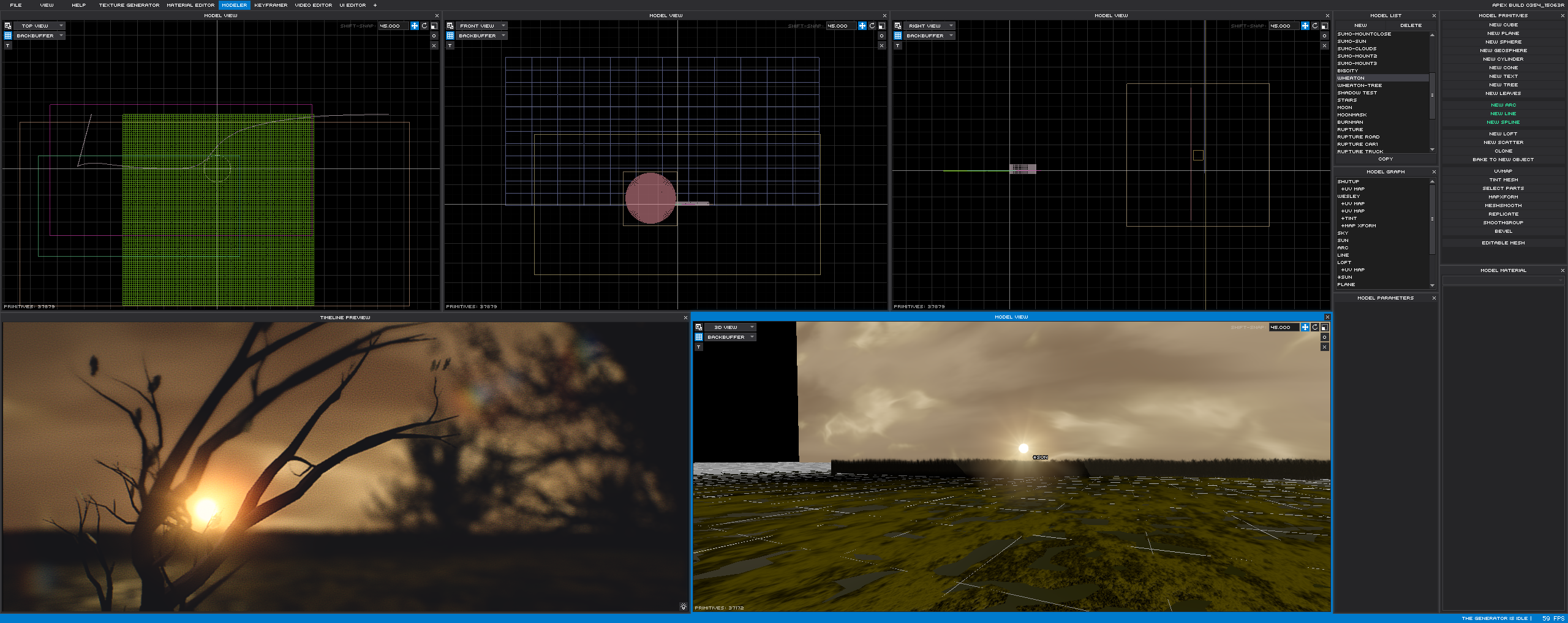
The dark city buildings as they appear in the tool used for DLYEUM
Other than these two changes, the rest is basically the same as originally: the mesh generation, animation and especially the timeline concept has stood the test of time.
One thing that had the largest impact was the reduction in the turnaround time when creating visuals, and the evolution of our tool was partly driven by this. The fact that we can go back to a scene and modify a texture or a model and immediately see the result in all its post-processed glory helps immensely in achieving the quality that we'd like to put on the screen. In short: the concepts are the same but more refined, and built into a tool that is "production ready".
2) Same question for the synth used in both intros.
For the first two intros ("project genesis" and "a place called universe") we used a rudimentary tracker+sample generator combo that we knew wouldn't last, but it did the job at the time.
Since "Beyond" we've been using the same modular framework for audio, which allows us to do incremental upgrades without losing any of the familiarity or having to worry about the actual audio engine. It also allows us to deprecate modules that we no longer want to use.
In this particular intro we've tried a few techniques that we felt were needed to match the subtlety of the imagery, and the relatively small (initial) scope of the intro allowed us to experiment without the responsibility of having something that is a permanent solution.
3) Is there a "story" behind DLYEUM?
There is, albeit a loose one.
The initial concept was to create something dark and looming as a sequel (or spinoff) to our other intro called "One of these days the sky's gonna break", but there was no story or storyboard, just a bunch of scenes that we thought would fit together. The narrative created by the final intro is open to interpretation, and that was kinda our goal too: let the viewer fill in the holes, and make up a story of their own if they want to, which we've been happy to see that people have been doing.
4) The silhouettes in DLYEUM are great and original. Are those 3D models? Can you tell a bit more on the tech used to build them?
There were plans to create the human figures in 3D using primitives, but ultimately we imported small vector images and processed them a bit further in the tool to add more detail.

At the end, the simplest ideas are the best ones. Zoom in to spoil the magic
5) Did you have to do some size-fighting to stay under 65535 bytes for DLYEUM or you managed to include everything you wanted in the intro?
We ran out of time before we ran out of space, but just barely. We had 53 bytes left when the deadline came - we have never been so close before. The final version is going to be a challenge to do, because with the lack of time and sleep came the loss of quality in some scenes, which we want to remedy with a proper release. We have no definite timeframe for when that's gonna happen, but we hope to have it released by next week [4th to 8th of april 2016 for who's reading].
6) Did the result of the party (you came 2nd by 2 points, 1890 to 1888) disappoint you, or you think Mercury deserves the 1st place? Has "fermi paradox" something "more" than DLYEUM in your opinion? Be honest.
At this point the results don't matter, this is how it was meant to be.
The Mercury guys are very good friends, and having seen how much work they put into their release, we're happy either way. The two point difference just shows that the audience couldn't decide between the two intros either, and neither could we - like we said at the prize ceremony, "I guess we're even now".

I expected an answer a little bit more on the line of "Who is the best now YOU MADAFAKAZZ?"
We're happy with the way our intro turned out, we're very happy that the competition was tough again, and most importantly that 64k is back with a vengeance.
We still think it's the perfect demo platform.
7) I asked the same question to IQ some years ago for 4k intros: where are 64k intros headed from here to 10 years in the future? In my opinion, with 4k intros the scene hit something like an "hard edge", so someone had to "invent" 8k intros to go ahead. 64k seem still capable of impressing the audience.
If 4k (and especially recent 8k) intros are any indication, 64k still has a lot left to offer, although we don't think this is fundamentally about size limits.
We're not using any special technology in our intro, it's simply about how you present your content with the help of proper composition, framing, and coloring. This is what usually makes an impression in demos too, and if you do it in 64k, it's an added bonus.

I can't stop shivering when I look at that house. Even in that demotool.
4k seemed to hit a "hard edge" mostly because everyone and their mother started using distance fields/raymarching, which resulted in very similar-looking intros and a lot of people got bored of that.
We have already passed the point in the evolution of the demoscene where putting random flashy imagery one after the other doesn't cut it anymore, or let's say it doesn't really stand out. A few people commented on Pouet that finally they are starting to see inspiration being pulled from outside the demoscene, and that's where we can still improve, or at least it's one direction. The old demoscene conventions and "bring back the only demo art" have their place and we must know where our roots are, but from time to time it's worthwhile to take a look around in the world of film and other artistic media as well.
We definitely don't mean to stop trying to push the limits, but they have to be pushed both technically and artistically.
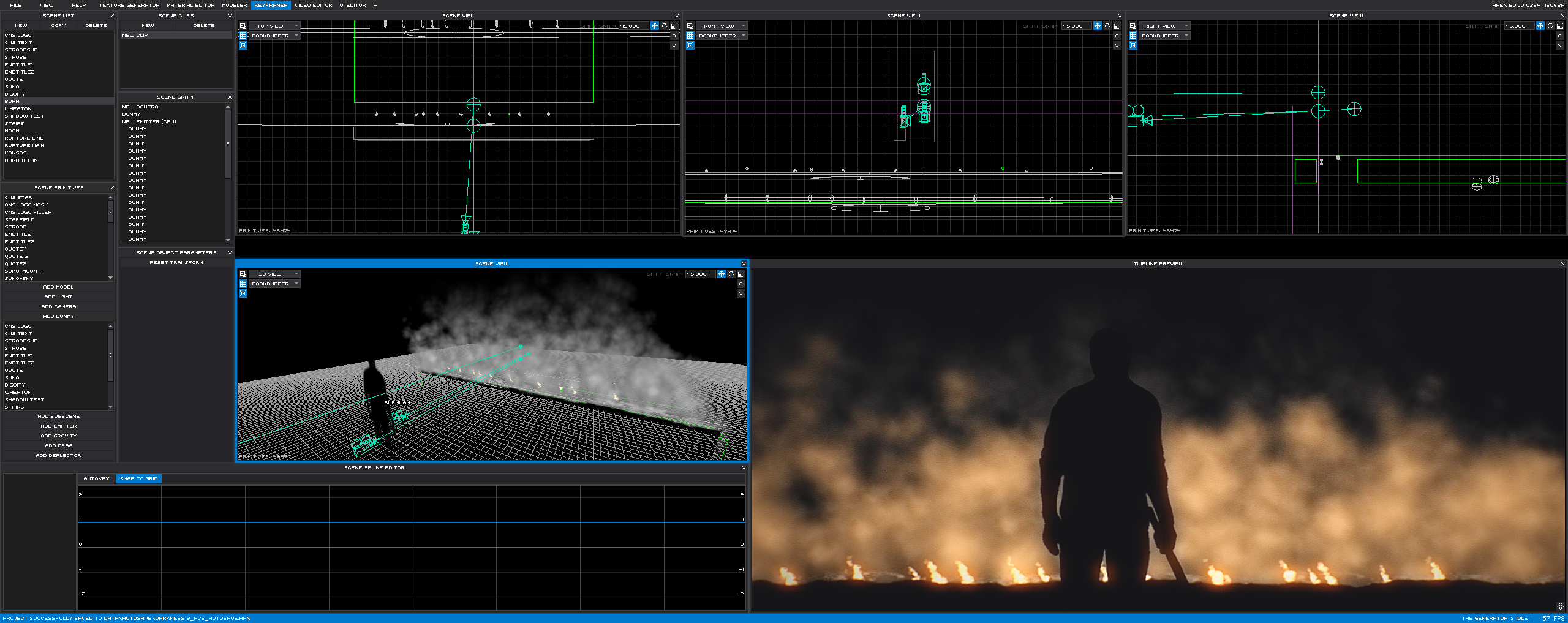
P.S.: for the maniacal guys out there or for those who want to spy the secret technology behind Conspiracy's intros, I've put two additional *BONUS* *EXCLUSIVE* *SCREENSHOTS* of their demotool here and here. Rip... errr... enjoy!!!
[The timeless way of building a 64k...]
A strange story and a masterpiece intro
A strange story and a masterpiece intro
"Do you know how many of these you can fit on a 1.44Mb diskette?"
Yeah, you probably do. The answer, by the way, is 1.474.560/61.952=23,8. Or maybe 42. Or maybe you have to take into account the space allocated for the boot sector, the FAT and the root directory. So that would really be 1.457.664/61.952=23,52. But I'm just digressing. The truth is that we want to talk about this 61.952 bytes intro (sometimes known also as "64k") that threw millions of coders into panic since the first frame appeared on the megascreen.
Yeah, because Mercury has *hexagonal* *lens* *flares*!
Yeah, because Mercury has *dust* *on* *the* *camera*!
(Did I say they have hexagonal lens flares?)

Hexagonal church
There were those two coders, urs and cupe, that had nothing to do that day, and were greedly devouring their copy of "The timeless way of building", a book by Christopher Alexander that explains how to create beautiful buildings using design patterns and blue screens of death.
Suddenly, urs said: "Hey, why don't we do a 64k for Revision, a 64k that has nothing to do with this book except for the title?!". Cupe answered: "Yes, that's a great idea! People will try for ages to understand what this book has in common with the intro, except for the title!!".
Unfortunately, in the next days, ideas were lacking (as usual).
But why inventing something when you can copy?
Yeah, that's a design pattern! That's the beautiful truth Christopher Alexander taught us!
So they started with an ocean scene, copied from NeHe's tutorial number 12, but adding *hexagonal* *lens* *flares*. Then urs came with a great proposal: "14 years have passed from fr-08: the product. It's time for another church scene, with multicolour glass and, obviusly, *hexagonal* *lens* *flares*". But cupe said: "Hey, I think people still remember that scene...". And urs: "Nah, just add more dust on the camera and that will be fine".
Things were going on steadily.
Urs added three or four camera paths "a-la-Elevated", one Still-esque scene with nonsense trapezoidal buildings, some more dust and, obviously, *hexagonal* *lens* *flares*. Then, the stroke of genius hit cupe: "Urs. Hey urs. I've got it. I've got our main scene for the intro. People have never heard of this". Urs said: "What's that?". And cupe: "Get ready: a *city* *scene*". Urs: "You mean... a scene with buildings, shadows, fog, reflections, hexagonal lens flares and all the rest...?". Cupe: "Yeah! That's fantastic! A scene where the buildings move like in Incep... err, where the buildings move!!! Isn't that insane?". Urs: "Yep...".

Trapezoidal buildings
Only one thing was missing: one majestic closing scene. Cupe&urs where out of ideas (as usual). In that precise moment, las came out of nowhere and said: "Guys, I've got your definitive, psychedelic, groundbreaking final scene! Listen: think of Times Square at night, think of the lights, the illuminated signs, the cars running and their lights reflecting on the wet asphalt!!! Think of that!". But cupe&urs said: "Are you joking? One scene with *cars*? What is this, some sort of 1992 Amiga prod? Or "Rush Hour" by nextempire???". And las: "But you know, this night scene, with some hexagonal lens flares...". "Oh, shut up and go back to your framework, you silly framework coder!". And las sadly went away.

Glared sunset stoups
The entire Mercury team was adding the last bytes to the intro. And a couple of hexagonal lens flares here and there. Deadline fastly approached. Then Okkie announced their 64k. Lights went out, strangely there was silence in the hall in Saarbrücken.
"The Timeless" started running on the screen.
Two coders committed suicide just as the first sea-wave rolled in. All of cupe's and urs' lives were passing in front of their eyes.
At the 10th hexagonal lens flare, many heads exploded just thinking of how the hell did they do that.
"The Timeless" was a milestone.
And at last, the final scene, some night city with cars, yes cars, and neon signs glared on the screen.
Las said: "But... you put this scene... this was my scene...", to whom urs&cupe answered:
"Shut up, you silly framework coder!".

You silly framework coder!
That's how a successful 64k is born.
Because, you know, it's not important if you copy 10 thousand times from Debris, it's not important if your scenes have no logical link, it's not important if a city scene has been seen in 4879128 different intros.
No, that's not what counts.
What counts, dear friends, is *hexagonal* *lens* *flares*. All of them.
Remember that.
 the Tunnel - demoscene blog